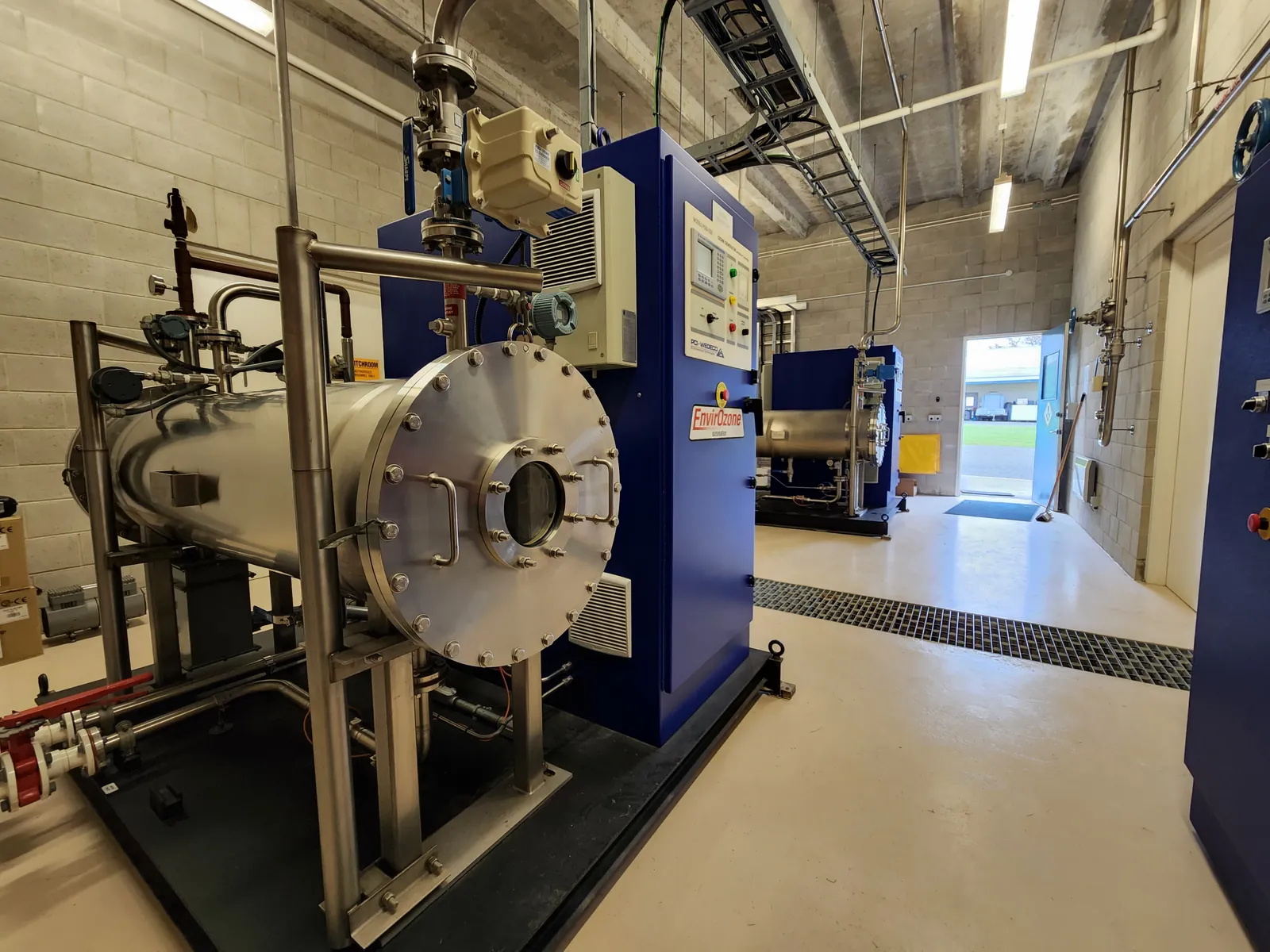
- What are industrial ozone generators used for?
- Industrial ozone generators feed large-scale water and process applications: municipal drinking-water plants, major food and beverage processors, large RAS aquaculture, dairy CIP, industrial cooling-tower disinfection, advanced oxidation for difficult contaminants, and process water for wineries and breweries. Typical capacities run from 500 g/hr up to several kg/hr.
- Can ozone reduce chemical use in industrial water treatment?
- In many applications, yes. Ozone replaces or supplements chlorinated sanitisers, peracetic acid, hydrogen peroxide and other oxidising chemicals — generated on-site from oxygen and air, so there is nothing to truck, store or handle. Whether ozone is the right fit depends on the contaminants, flow rates and downstream requirements, which we assess in the design phase.
- Is ozone suitable for food processing and wineries?
- Yes. Ozonated water is used for surface disinfection, CIP, washdown, barrel sanitation, cool-store mould control and packhouse hygiene. Because ozone reverts to oxygen it leaves no chemical residue on food-contact surfaces. See /solutions/breweries-wineries and /solutions/dairy-processing for application detail.
- What monitoring is needed for industrial ozone systems?
- Standard monitoring on an industrial ozone system includes dissolved-ozone concentration in the treated water, ambient ozone gas concentration in the plant room, generator output current and power, feed-gas flow, pressure and dewpoint, and contactor / destruct temperatures. All data is logged in the local PLC and is normally exposed to the site SCADA.
- What safety controls are required?
- Industrial ozone systems are designed around a defence-in-depth philosophy: ambient ozone detectors with alarm and shutdown, dissolved-ozone monitoring with high-limit interlocks, an ozone-destruct unit on contactor off-gas, pressure and temperature interlocks on the generator, ventilation interlocks, clearly labelled isolation valves and operator training. All controls are documented in the system FMEA and HAZOP.
- Can Ozone Technologies design and service systems in New Zealand?
- Yes — design, manufacture, installation, commissioning and ongoing service are all delivered by our own team from Napier. Critical spares are held locally and we offer scheduled service contracts and remote monitoring options. To scope a project, contact us at /contact.